Showing posts with label Read Alouds. Show all posts

Monday, December 16, 2013

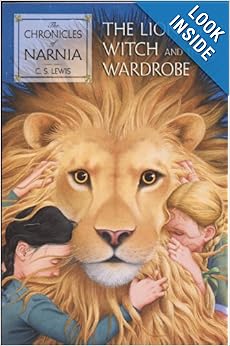
The Lion, the Witch and the Wardrobe

As a Christian mom, I feel like it is almost required for me to read C.S. Lewis' The Lion, the Witch and the Wardrobe to my kids.  I finally have gotten around to reading it to them and they have enjoyed it. 
I tried to explain to the girls that this was an allegory and Aslan was God, the White Witch was Satan, etc.  Neither of my kids seemed to understand that at all.  Perhaps they are still too much of "concrete thinkers."  So the theological lesson is not getting through to them, but they are enjoying it as a story.

I have never read any of the other books in the series, but the girls are enjoying this one, so I may try the others.

Sunday, December 15, 2013

A Lion to Guard Us

Catherine's literature curriculum requires that we pick four novels and read them.  This is our first one, and is proving to be far more interesting than the reading that is in her actual literature book.  For each chapter, she has vocabulary, questions, and a writing assignment.  After every five chapters, she takes an online test. 

I have never read this book and have enjoyed reading it with her.  She is still a slow reader, so we alternate reading pages out loud.  This book is A Lion To Guard Us by Clyde Robert Bulla:
The book opens in London in the 1600's.  The three Freebold children and their mother live with a wealthy family, as servants.  Their father has gone to Jamestown, Virginia, to start a new life for them.  The mother dies and the children decide to go to Virginia by themselves.

There is quite a bit of action in the novel as the children have to get on a ship and sail across the Atlantic Ocean.  They survive some storms and eventually crash into Bermuda.

This is a great novel to really teach the children what it must have been like to be an American colonist.  These types of "living history novels" are so much more interesting and effective than mere textbooks!

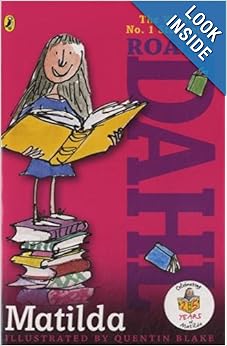
Matilda

Roald Dahl is one of our favorite authors.  I finally picked up Matilda at the library.  Like all of his other books, this one was silly, full of action, and the girls loved it.

Matilda is a five year old girl who, against her parents' wishes, reads.  A lot.  She is told to stay at home in the afternoon and watch "the telly."  (Dahl is British so uses different terms than Americans do ... which my girls find funny.)  Instead of watching television, she walks to the public library, teaches herself how to read, and then reads every single book in the children's section.

Then Matilda moves on to the adult section of the public library and reads classics such as all of the Charles Dickens novels.  All the time, her parents punish her when they find her reading.  So to get back at them Matilda stages practical jokes on her parents. 

Several chapters into the book, Matilda begins kindergarten.  Her teacher is a sweet woman who recognizes her brilliance and loves her.  The school's principal, Ms. Trunchbull, is horribly mean and wants "a school with no children to run."  Ms. Trunchbull is horribly mean and mistreats the children.

So, Matilda begins to play practical jokes on Ms. Trunchbull.  In time, Matilda also develops magic powers which she uses to get back at the mean adults in her life.

We also watched the movie, with Danny DeVito and Rhea Perlman.  It was very true to the novel and the girls loved it.  Like all of Dahl's books, the mean characters are VERY mean and the children are resourceful and clever. 

Saturday, October 5, 2013

Esio Trot

I am not sure why, but we have gotten out of the habit of reading chapter books.  The kids & I both love it, but I think we have just been so busy that I let that slide.  Part of my rationale was to encourage Catherine to read more on her own, but she is not doing so.  I decided to revert to one of our favorite authors, Roald Dahl.  In addition to his most well known books, he has written many novellas.  I had actually never heard of most of these, but we have thoroughly enjoyed them.  Most of them we can read in one sitting, or at most two sittings.
Esio Trot is, like all of his books, ridiculous.  The plot has lots of action and is completely implausible.  There is quite a lot of suspense and you really want to know what happens.  The illustrations are equally silly and the kids were enthralled.  What makes this book different from his others is that it is actually a romance story.  Despite the "love" element, it is not at all gushy or emotional - it is classic Roald Dahl and I recommend it highly for boys & girls. 

Saturday, June 1, 2013

On the Banks of Plum Creek

Quite awhile ago we read Little House in the Big Woods (about the Ingalls family moving out west) and Little House on the Prairie (about the family building their log cabin).  We loved both of them.  The third book in the series is Farmer Boy.  We started it and hated it, so we gave up on it.  Then a  few months passed and I decided to try the fourth book in the series, On the Banks of Plum Creek.


We loved this one too!  The family moves to Minnesota (I am not sure why).  They live in a "dugout," which is a cave carved into a hill.  They live within a few miles of a town, so Pa gets a job with a neighbor.  Once he starts earning money, Pa is able to build a house for the family.

The kids attend school for the first time, as well as church.  Living near a town for the first time also leads to a lot of new experiences for the girls, such as having playmates and attending parties.  The characters of Nellie Olsen and her family (well known from the television series) are introduced.

The family also experiences Christmas, grasshoppers destroying their crop, and a tornado.  There is a lot of hardships in these stories.  Sometimes I forget how pampered our modern lives are until I read books like these.

Tuesday, May 7, 2013

Stone Fox

Tonight we finished a book I had never heard of before: Stone Fox by John Reynolds Gardiner.
This book is set in the mid-1800's in Wyoming.  It is simply written and is supposedly based on a "true" legend. 

The protagonist is Willy, a ten year old boy.  I spent the entire book shocked at the maturity, responsibility, resourcefulness, and ingenuity of a ten year old boy.  My kids do not walk to the end of our driveway to get the mail by themselves.  They have essentially no real "chores," they just do what we tell them.  They do not prepare their own bowl of cereal or pour their own glass of juice.

Willy's parents are deceased and he lives with his grandfather on a potato farm.  One morning his grandfather doesn't get out of bed and is unable to speak.  Willy doesn't know what to do, so he gets the town doctor, who happens to be a woman.  She comes over and diagnoses Willy's grandfather with having "lost the will to live."

The doctor suggests that Willy go live in town with someone else and have his grandfather live in the local boarding house, where someone can take care of him.  Willy declines her suggestion and chooses to run the farm by himself (I know, he is ten).  So, Willy gets up before daybreak every morning and takes care of the farm.  He hooks his dog, Searchlight, up to a plow, plants the potatoes.  Later, he harvests the potatoes and sells them.

In order to prepare for the winter, Willy (at the age of ten) withdraws money from the bank and goes to the local general store, where he buys all the food & supplies he will need for the winter.  He then does all the cooking, cleaning, etc. for himself.  He makes oatmeal for his grandfather and spoon feeds it to him every day.  He gives his grandfather sponge baths and combs his hair every morning.

Willy rides his sled, pulled by his dog, five miles into town every day during the winter to attend school.  My girls thought it was cute that his dog sits outside the school, in the snow, and waits for him all day.

One day the "tax man" arrives at Willy's door.  He claims that his grandfather has not paid taxes in ten years and they owe $500.  The tax man is threatening foreclosure.  Willy (and the doctor) then surmise that this is the reason why his grandfather has "lost the will to live."

Willy decides to enter a dogsled race; the prize money is $500 - exactly what he needs!  The entry fee is $50, so Willy goes to the bank, meets with the bank president, and withdraws the money from the bank.  My kids think of a bank is "that drive through place where we get lollipops."  Of course now if a child walked into the bank by themselves to withdraw money, with no parent present, the police would be called.  Of course, no child would be allowed to live by himself on a farm with a bedridden elderly relative.

I won't tell you the ending, because there are some interesting twists.  I do recommend this book as a simple read with some action.  There are a lot of resources on the Internet to accompany this book.  I found lots of project suggestions, worksheets, etc.  We did not do any of those.  We are so busy with all of the other things we do, that I treat the chapter books we read as just fun, easy time. 

The book is set in a simpler time - with no television, computers, phones (the girls asked why Willy had to go into town to get the doctor rather than call 911), etc.  Interestingly, like many other books we have read set long ago, the children are considerably more mature and responsible.  I wonder if we are devolving as a nation. 

I was inspired to teach my children more independence.  I am a bit embarrassed, but up until two days ago I still helped my children with their showers/baths.  After reading this book, I decided that they can handle this on their own.  So, now I am standing next to the shower coaching them (for now).  The shampoo/conditioner/body wash usage has skyrocketed.  They are not nearly as clean as when I helped them.  But, it has only been a few days and know they will improve.  It is still play time and they do not focus on "getting the job done" in the shower.  Maybe I'll actually assign them chores soon!
Sunday, May 5, 2013

The Chocolate Touch

I chose this book as a read-aloud because it was an interesting twist on the myth of King Midas, whom we studied last year.  Patrick Skene Catling has written a funny, unpredictable book:
The book relates the story of John Midas, who loves candy, especially chocolate.  He is given what turns out to be a magic piece of chocolate.  After eating it, everything else that he eats or drinks becomes chocolate.  Then everything he touches with his lips becomes chocolate.  The hilarity is very juvenile ... he gets in trouble because he cannot do his math work after his pencil turns to chocolate.  My girls found this hysterical, reminding me of the joy they had with Roald Dahl books.

The book has a happy ending with a "moral" lesson about selfishness and thinking of others.

Like I said, the girls laughed throughout the book and spent days "acting" it out.  It is a quick read and took us two sessions.  It is a fairly easy to read chapter book and a newer reader can probably handle it.  Also, I think a boy would love it as much as my girls did.

Saturday, May 4, 2013

Sleeping Ugly

My girls love fairy tales, so I got this chapter book - which puts a big twist on things!  Jane Yolen has written a fast paced, cute story which really made the girls think about the plots and characters of fairy tales.
The book is about a beautiful, yet mean princess.  There is another girl in the country who is sweet, but physically ugly.  A lot of elements from various fairy tales are incorporated in this story.  We just read it for fun, but it would be interesting to do some comparisons with this book and other fairy tales. 

This is an easy read and we were able to read it in one sitting.  But, I don't think a boy would appreciate it.

Friday, April 26, 2013

Child of the Silent Night

Quite some time ago we studied Helen Keller.  Then my Dad invited us to see a production of The Miracle Worker at a local theater in Jasper.  The girls loved the play, so I borrowed the movie for them to watch.  We have subsequently read some short books about Helen, as well as her teacher Anne Sullivan.  Ms. Sullivan attended the Perkins Institute for the Blind in Boston.  They act out scenes from the play and talk about Helen Keller frequently.

So I was thrilled when I found this chapter book, Child of the Silent Night by Edith Fisher Hunter, about another deaf and blind little girl:


The book relates the true story of Laura Bridgman, who suffered from scarlet fever when she was a two year old.  That fever left her deaf and blind.  She lived in the country and one of their neighbors took her on walks frequently to allow her to touch leaves, bark, small animals, etc.  The book does a great job of explaining how little aspects of life would be different if you were unable to hear or see.

I was particularly impressed that Laura, who was deaf and blind, was able to set the table for dinner at the age of seven.  My girls can barely set the table now, and they have all of their senses.  Yet another book that makes me feel that I am not teaching my kids to do enough around the house!

Eventually Laura goes to live at the Perkins Institute in Boston, where she is one of the first deaf and blind students they have.  Some of the techniques developed to teach her were later used with Helen Keller, fifty years later!

Robby was able to listen to me read this story to the girls.  He kept asking "Why have we never heard of Laura Bridgman but have heard of Helen Keller?"  Good question.  I guess the easy answer is that Hollywood made a movie about Helen, but not Laura.  Their stories are quite similar.  This was a good lesson for the girls - that there are other people who exist in the world who are deaf and blind.  Not just Helen Keller.

About ten years ago I went to the Netherlands for two weeks.  Like every other American, I had read Anne Frank's Diary.  So, like every other American tourist, I visited the Anne Frank House in Amsterdam.  It was, of course, very moving to see the small rooms in which Anne and her family resided until they were taken to the concentration camps.  What impressed me more, however, is that all over the Netherlands there are other World War II era houses which you can visit which housed secret rooms in which Jews hid from the Nazis. 

For some odd reason, it never crossed my mind until I saw all those other secret rooms in other houses that the Franks were just one of many families all over the Netherlands, and Europe, who had to hide from the Nazis.  Because she happened to keep a diary, and her father happened to survive the concentration camps and publish it, we have all heard of Anne Frank.  But her story is not unique.  It is simply well known. 

Horrible Harry Bugs the Three Bears

I can't remember how I ended up selecting this book to read to the girls.  I spend time late at night reading other people's blogs and then order books which sound interesting from our library.  Then a few days or weeks later the books become available, I get them, and we read them.  Sometimes I have no idea why I requested it.

This book was interesting because it occurred in a third grade classroom in a traditional school.  So that introduced the girls to a different life than they lead.

The girls laughed a lot during this book and enjoyed the story. It is part of a series of books and we may get some others from this series.  They are easy enough readers that Catherine should be able to read them on her own, but she hasn't taken that leap into reading chapter books by herself yet. 

So Suzy Kline's Horrible Harry Bugs the Bears was one of the books we read this week.  It is a formulaic book and fairly simple, but I am glad we read it anyway:

The book is about a class whose teachers divides the students into groups.  Each group must choose a fairy tale and perform a skit about the fairy tale for the whole class.  These kids chose the fairy tale Goldilocks and the Three Bears.  One of the members of the group, Harry, loves bugs and finds a dead earwig on the playground.  He takes it home in a tissue and buries it.

He then wants to incorporate the earwig into the fairy tale, which the kids are able to do.  The children in the story get props, paint a background mural, make costumes, write a script, have a narrator, and do a pretty thorough job of putting on a mini-play.

My girls found the book funny and laughed a lot throughout it.  I loved that this book was a great vehicle to introduce the girls to various steps in the process of theater.  A few days after we read this book, we passed a wig shop.  Catherine stopped and said "these are like the wigs in the Harry book."  I had completely forgotten about that book, but Catherine remembered some of the details in the book.

Then, a few days after that, we saw a play.  Sabrina pointed to the stage and said "Is that a background, Mommy?"  I am sadly continuously shocked at what my kids don't know.  I tend to be very narrow minded and think that my kids know everything already.  So when my kids ask a question like "Is that a background, Mommy?" I am reminded that my children are still only 5 and 7 and they really do not know this stuff.

The biggest thrill which I had as a result of this book was tonight.  We ate dinner at a place where the girls could play on a stage while we were eating.  Catherine came up and said they were going to act out Goldilocks and the Three Bears.  They had no props, background, or costumes.  But they pretended to knock on a door.  Then they pretended to eat three bowls of porridge, pretended to sit on three chairs, then pretended to lay down on three beds.  Then Sabrina roared at Catherine, pretending she was a bear, and Catherine ran off the stage like she was Goldilocks fleeing the bears' cottage.

Then the girls told me they were going to act out Cinderella.  They stood in the middle of the stage.  Catherine screamed "It's midnight!"  She took off one sneaker, dropped it onto the floor, and ran to the corner of the stage.  Sabrina very carefully carried the sneaker to Catherine and attempted to fit it onto her foot.

Lastly, the girls acted out Sleeping Beauty.  They have done this many times before, but not on a stage.  Catherine laid down in the middle of the stage as still as she could.  Sabrina came over and kissed her, waking her up.

The girls put no preparation or planning into these mini-skits they did, but they had a blast.  I was pleased to see how they were able to act out scenes from these fairy tales, including picking out the most important scenes.  I may actually assign them "do a skit" again.  Bravo to this chapter book, which introduced them to some elements of the theater!

Tuesday, March 12, 2013

The Sword in the Tree

The author Clyde Robert Bulla comes up frequently in children's literature.  He has written tons of books.  I chose this one because we just finished our Middle Ages study:
The book was ... OK.  It was an easy reader and went quickly, but it seemed pretty formulaic.  It is the story of Shan, a young boy.  His father is Lord Weldon; he and his family live in Weldon Castle.  His uncle Lionel returns to Weldon Castle, fakes his father's death, and stages a coup.  Shan and his mother flee the castle and travel to Camelot.  They ask King Arthur for help in ousting his uncle and regaining control of Weldon Castle.

The girls enjoyed it because it includes all the essential props of a Middle Ages story: a castle, knights, a sword, horses, lances, a dungeon, etc.  There is a reasonable amount of adventure and suspense.  I, however, did not like the book as much because it's not very creative. 

The Story of Doctor Dolittle

This is a classic children's book which I remember loving as a child, so I thought I'd read it to my girls.  They loved it.  Hugh Lofting creates such an awesome world in this book:
A few chapters into the book, Dr. Dolittle decides to stop treating human patients and begin treating animal patients.  His sister, who is his housekeeper, gets mad and leaves.  Then the animals take over with all of the housekeeping duties.  Catherine said to me "this book got pretty silly pretty quickly - I have never heard of a dog sweeping the floor!" 

My girls do a great job of stopping me as we go and asking me to define words they do not know.  "Housekeeper" was one of the words they asked me to define.  Then, for the next few days, we try to use the word as much as we can to learn it.  Catherine of course has to put a princess spin on it, and reminded me that Cinderella was a housekeeper.  I told her that Snow White was also a housekeeper, for the dwarfs.

As the plot progresses, there is a crisis in Africa and lots of monkeys need medical care.  Dr. Dolittle and his house animals travel to Africa to treat the monkeys, then they travel back to England.  On the way they shipwreck, encounter pirates, and have quite a few adventures.

Over the summer Catherine went to geography camp (I know, only home schoolers would do that to their children).  She learned some songs and dances relating to maps.  One song she learned was about the countries of northern Africa, which included a wing/arm-flapping step for the Canary Islands.  For weeks after geography camp, she did those songs and dances.  But we have not done them since. 

When we read the part of the story in which Dr. Dolittle lands on the Canary Islands, Catherine was screamed out "I know where that is!" and sang song.

I highly recommend this book.  It is silly, adventurous and teaches a little bit about geography!

Saturday, March 2, 2013

Bears on Hemlock Mountain

This book was assigned with our Language Arts curriculum last semester, but we never got around to reading it.  It has been sitting on a shelf waiting for us to get to it.  We just read another book, by this author, so I thought it would be a good time to read it.  We enjoyed it - even more than The Courage of Sarah Noble.  It has the same simplicity as Courage, but more action.  The Bears of Hemlock Mountain by Alice Dalgliesh was a hit:
The plot, like in Courage, was simple.  The main character is an eight year old boy, so this book would appeal to a male reader more than Courage.  The book is set near a mountain in a time before they had telephones.  The protagonist, Jonathon, is from a large family.  His mother is planning a lunch (following a christening) for 23 relatives.  She needs to borrow a "big iron pot" from one of Jonathon's aunts so she can make a stew for that lunch.

She sent Jonathon on an errand: to walk over Hemlock Mountain to his aunt's house and borrow her "big iron pot."  Jonathon loves animals and brings carrots for the rabbits, nuts for the squirrels, and bread crumbs for the birds.  But, he fears the bears of Hemlock Mountain. 

Needless to say, he accomplishes his errand and he encounters bears on Hemlock Mountain.  But, nothing scary or potentially upsetting occurs in the book.  It is completely G-rated. 

The girls enjoyed the book and I was able to read it to them in one sitting (about an hour).  We were able to discuss what a christening was, why Jonathon's aunt did not know why he was visiting her (because there were no phones), and how young children at that time could be sent by themselves to walk in the woods, interacting with wild animals.  It is so different from our lives: I don't even let my girls walk to the mailbox by themselves.

Friday, March 1, 2013

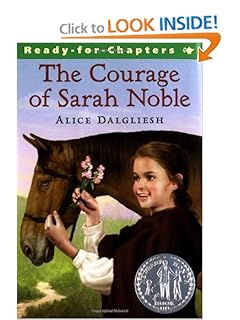
The Courage of Sarah Noble

One of the easiest things we do home schooling is reading chapter books.  My girls eat it up!  We just read a book which I have seen on various curricula, The Courage of Sarah Noble by Alice Dalgiesh.  It was a Newberry Honor Book and is apparently based on a true story.  The girls enjoyed this sweet, 52 page book which is so simple I was able to read it to them in one sitting.
The plot is very simple.  Sarah is an eight year old girl in a large family.  Her father has purchased land in the wilderness of Connecticut.  He and Sarah leave their family and trek to the land.  They then live in a cave while they build a house.  Once it is completed, Sarah lives with some friendly Indians for a few months while her father travels back to get the rest of her family.

There is very little action in the book, but it does illustrate a different time in America - with wilderness, people building their own homes, and the presence of Native Americans. 

When some of the Indian children find Sarah in her cave by herself one day, she has no idea what to do.  So, she pulls out her Bible and reads it to them.  She then learns their language and she learns hers.  Thus begins a friendship which leads to her staying with them while her father travels back to get her family.

Another interesting chapter which led to a lot of conversation was about Sarah's night time prayers.  While she was living with the Indians, she continued her practice of praying to God every night.  She prayed for her parents and her siblings.  Then she debated with herself if she should pray for the Indians.  She prayed to God "If you take care of the Indians, please do."  We were able to talk about God's love for all people in the world, even non-believers.  We talked about intercessory prayer. 

When her father returns with her mother and siblings, there is, of course, a happy reunion.  But, after having lived with the Indians for several months, Sarah now dressed and acted like them.  Her father quickly made her change her clothes before her mother saw her.  This also led to some interesting discussions about prejudice. 

So, I'd recommend this book as a quick, simple read.  But, it is not very exciting or fun.  It is well written, but I kept wondering when is something going to happen?

Wednesday, January 23, 2013

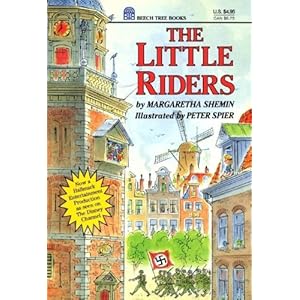
The Little Riders

My girls loved this book, set in Holland during World War II.  The main character is a young girl, Johanna.  The Little Riders of the title refers to small statues found in a clock of a church steeple.  My girls asked me to read this (as opposed to groaning sometimes when I tell them it is chapter book time).  Once in the car Catherine asked me what I thought would happen to the Little Riders, telling me that she was thinking about this book even when we weren't reading it!
Churches in America typically do not have decorative clocks like they do in Europe, so the girls were fascinated at how the entire town loved the "little riders."  Johanna's parents travel to America for a few years, so she must live with her grandparents.  Her grandfather is the caretaker for the church steeple.  Johanna helps her grandfather care for the statues.

The Germans requisition Johanna's bedroom for the duration of the war.  The book does a great job of describing how Johanna has to pack up her bedroom and move into the attic.  The Nazi officer then moves his belongings into her room, which saddened my girls.

The plot then proceeds to Johanna, her grandparents, and the town taking steps to protect the little riders from the Germans, who want to melt them down for bullets.  The girls were intrigued and very curious about what happens to the little riders.  I loved all the suspense the author created - my girls were eager for me to read each chapter to them.

We loved this book and I highly recommend it.  The book does an excellent job of bringing to life an historical time period: of occupied Holland during World War II.  The questions my girls ask me during our reading always tell me how much they understand and grasp what we are reading.  With this book, I got these questions:

How long will the war last?
Why can't they just buy more bullets?
Why did they hate the Germans?
What is rationing?
What is liberation?  Occupation?
Why does Captain Braun do what he does (I'll leave that a secret ...)?

Our discussions remained fairly basic because of my kids' ages, but older kids could really explore a lot of moral dilemmas in this book.  It is an excellent illustration of occupation and liberation and would be a great resource to someone studying World War II.  This book is only 6 chapters, 70 pages. We read it in 3 days.

Monday, January 21, 2013

The Minstrel in the Tower

I get a lot of my chapter book ideas from the Sonlight web site.  This one, The Minstrel in the Tower by Gloria Skurzynski, is set right after the Crusades, in the year 1195 AD.
The two main characters are children, a boy and a girl.  Their father fought in the Crusades a few years ago and has never returned.  He is presumed dead, which led to an interesting discussion with my girls about the lack of communication and information in the year 1095.

The children's mother is ill and asks the kids to travel afar to get her brother, an uncle that they have never met.  It is several days away, and the children have to walk.  They have no money.  Instead, they have a lute.  Their plan is to play their lute for strangers that they meet on the way in exchange for food.  My girls were shocked that these kids will walk for several days, by themselves, to try to find a potential uncle.  Chapter books have done a great job of introducing my kids to completely different lives!

Along the way the kids locate a tower, in which they spend the night.  They are kidnapped and held for ransom by two men, who realize that they are actually the children of a famous nobleman.  They plot their escape, and all turns out well.

This book was OK.  I wish I liked it more.  It was a quick read; it only took us two days to read it.  But, there is very little character development - you really do not learn much about the kids and do not really care what happens to them.  The plot is presented fairly matter or factly, with very little emotional descriptions. 

The setting is of course very different than our current day lives, but it is not described very well.  I wish the author had spent more time explaining what the Crusades were, what it was like to have their father gone for several years with no information about what has happened to him, what the children did during the day, etc.  The book neither describes the historical events during which the novel is set nor the daily life of that historical time period.  As such, the book is boring and not very educational.

Wednesday, January 16, 2013

BFG

We have thoroughly enjoyed the most recent Roald Dahl book we read: BFG.  I have heard of it, but never read it.  I am so glad we read this; the children loved it.
This book scared me at first because in the first chapter a giant kidnaps a child during the night and carries her off into his cave.  I do not have the time to pre-read the chapter books we read and many of these I have not read before and do not know the story.  So, I wondered while we read this if this would be a scary story about monsters, causing the girls nightmares.

Nothing could be further from the truth.  The story quickly turned to funny and lighthearted.  The plot line is silly and the girls actually laughed out loud during some parts.  Like all of the other Dahl books we have read, there is quite a lot of action in this book.  The plot has lots of twists and turns and is not at all predictable.

The BFG (Big Friendly Giant) had no parents and did not go to school. So, his grammar skills and vocabulary are poor.  His subject-verb agreement is frequently incorrect and he simply makes up words when he doesn't know what something is called.  The made-up words were funny.  He will say things like "I is whizzpopping my flubergusther over there."

The girls loved his made-up words.  Sabrina started to make up words all the time, asking for casssabellaterrish for dinner, for example.  I was pleased that Catherine's grammar is good enough that she noticed the BFG's errors.  She kept correcting them for me. 

Some of the scenes were hysterical.  The girls constantly try to fold their ears down to give their little princess figurines rides like the BFG does for Sophie (the little orphan girl).  The girls actually asked me to re-read the chapter describing some of the dreams the BFG keeps in the glass jars.  Sabrina sometimes looks out the window at night to see if a giant carrying a long trumpet is walking down the street.

The only criticism I have of the book is that it was a bit long.  Some kids may have trouble sustaining their interest for a long enough time to get through the whole book.  But if they can, it is worth it.

Wednesday, January 9, 2013

Squanto, Friend of the Pilgrims

We just finished one of our few non-fiction books ... a biography.   I loved being able to teach the girls about a new genre of literature.  This was also educational for me, as I did not know this story.  I wish we had read it in November though, right before Thanksgiving.
Clyde Robert Bulla has written a very readable story about a Native American at the time the Pilgrims came.  The book did a great job of explaining how there were two different worlds which collided: the Native Americans and the Pilgrims.  We were able to discuss the idea of "culture clash" some.  At one point one of the Pilgrims used the term "savage," which led to a great discussion with my girls.

Squanto ends up leaving his village and traveling to London with the white men.  He ends up being the star attraction in an "Indian Show," wherein people actually pay to gawk at the Native American.  Again, this was great fodder for an ethics debate with my kids.

After a few years, Squanto returns to America.  On the way to his village, he is kidnapped, stowed away in a ship and sold into slavery.  The girls had never heard of slavery before and were mortified. 

At the slave market, Squanto is actually purchased by some brothers at a monastery.  So, he goes to live in a Spanish monastery for a few years (lots of geography lessons here).  He eventually returns to America and seeks his home village of Patuxet (in modern day Massachusetts).

Sadly, his entire family and village have perished due to diseases brought by the white men.  Although this is a tragic event, the book is not sad.  We did talk about plagues and widespread disease.  This tied in well to the recent field trip we went on to the CDC Museum.

Unable to reunite with his village, Squanto goes to live with the Pilgrims and acts as a liaison between them and the Native Americans. 

The girls loved this book.  It really brought to life the world of the Native Americans.  A few days after we read this, Catherine looked at our history timeline and pointed to the Native American section.  She asked me if that was when Squanto lived.  I was thrilled that she is starting to piece together history.

Friday, December 28, 2012

The Year of Miss Agnes

I sometimes think that because I majored in American literature and worked for years in bookstores I should know "all" the books that exist.  How arrogant of me.  I am constantly amazed when I find a book which I have never heard of, by an author I have never heard of, that is just awesome.  This was one of them.  I am not sure if I found this title on the Sonlight website or another curriculum's web site, but it was a great historical book.  Kirkpatrick Hill has written a delightful, happy book.
The narrator is a ten year old girl who lives in a small (and I mean seriously small) village in the extreme northern parts of Alaska.  The book is set in 1948.  Each year the village gets a new teacher, mostly because previous teachers never stay more than one year. 

Miss Agnes is not like other teachers.  She wears pants!  She is from England, so she has a British accent.  But, most importantly, she awakens the children to the joy of learning.  Every chapter is about some new, wonderful thing she teaches them. 

She introduces them to a timeline by making one and hanging it on the wall.  She hangs a huge map on the wall and teaches the kids the continents, countries, etc.  She reads them chapter books (Catherine was so thrilled that she recognized some of the books Miss Agnes read).  They play math games.  She teaches them songs to learn spelling rules.

The village is so small that the school is a one-room schoolhouse.  The younger students who cannot read were initially given Dick and Jane beginner readers.  The students were Eskimos and could not relate to the plots and characters of the Dick and Jane books.  So, Miss Agnes made personalized beginner reader books for each child.  They included the child's own name, siblings, and parents.  The plots were about things that the children actually did: fish, trap animals, dog sled, etc.  The kids loved these books about themselves and read them repeatedly until they memorized them.  Then they would exchange them with other students.  Miss Agnes would make more personalized beginner readers until the kids became strong readers.  I thought this was a fabulous idea and need to do this with my girls.  It would take very little time and no cost to me, yet I think my daughters would love reading books and stories about themselves!

What I loved most about this book is that it is positive.  It is a happy, uplifting story about a group of students who are taught by a great teacher.  Their eagerness to learn is fostered and their whole world is expanded!  This is mandatory reading if you are studying Alaska or the Eskimos.  But I loved it because Miss Agnes has a passion for teaching ... a passion I sometimes have and sometimes don't.  It is an inspirational book to read as a homeschooling parent, even if you don't read it to your kids.

Friday, December 21, 2012

George's Marvelous Medicine

We just finished another one of Roald Dahl's lesser known books, George's Marvelous Medicine.  This reminded me of Animal Farm, because it is an allegory about family relationships, getting what you want, and what can happen to "mean" people.  The girls did not get any of the bigger messages, but they loved the story, which was ridiculous.
This entire book occurs on a Saturday morning.  Eight year old George is left home with his grandmother, who is mean and grumpy.  Dahl's descriptions of the grandmother are very nasty.  We would never use the terms he uses to describe another person.  But, the "villain" of the story does need to be bad.  She treats George pretty badly, calling him names and openly criticizing him. 

George's mother told him to give his grandmother her medicine at eleven a.m.  But, he gets so mad at her that he decides to make his own "medicine" to give to her.  He runs around his house and pours a bunch of random powders, creams, lotions, etc. into a big pot, which he boils in the kitchen.  This part kind of scared me, because I could only imagine my kids attempting to copy this activity.  We had a lot of discussions about what a "poison" is and that we can never "make a medicine."

In any event, George gives his grandmother the medicine and miraculous, if not hysterical, things occur.  The girls loved this portion of the book.  George (who lives on a farm) then gives the medicine to a hen.  Again, miraculous and hysterical results occur. 

George's parents return home.  His mother is horrified.  His father loves the results and gives the medicine to all the animals on the farm.  Then the father decides to have George create more medicine.  Of course George has no idea how he made the original medicine, so he has to guess what he put into the initial concoction.

Of course Medicine #2 is different than the first one created, so the results are different.  Yet, the results are hysterical and the girls loved it.  Medicine #3 and Medicine #4 also create funny results.

Dahl often has some "mean" characters in his books.  The grandmother in this book is certainly mean, and, as a result, gets her due.  In James and the Giant Peach, James is mistreated by his horrible aunts, who end up being squished by the peach.  In Charlie and the Chocolate Factory, all of the children besides Charlie are bratty, with indulgent obnoxious parents, suffer some silly, yet harmful, fate. 

This theme of mean characters suffering fantastical "violence" is common in Dahl's books.  Last week a man walked into an elementary school and killed twenty children and six adults in less than ten minutes.  I cry every time I think about that event.  I have been fortunate that I have been able to shield my children from news of those horrific events. 

I wonder if Dahl's books minimize violence by making it "funny."  There is nothing realistic about these books.  Many times there are magical powers which cause the "violent" results.  The main characters, generally the children, in these books are good and do not intend harm.  George makes his potion in an attempt to make his grandmother feel better.  The results are as much of a surprise to him as they are to everyone else.

I recommend this book for the fun plot.  Like all of his other books, it moves quickly and contains a lot of action.  If your children are savvy enough, you can discuss the character development and some overall moral lessons.